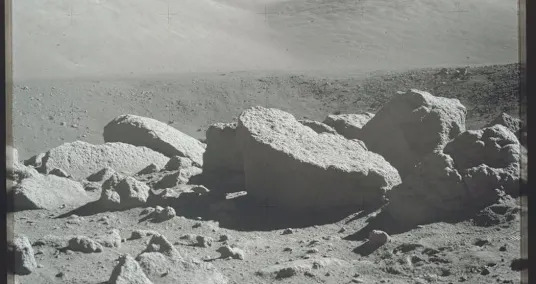
The Earth and the Moon may look very different today, but they formed under similar conditions in space. In fact, a dominant hypothesis says that the early Earth was hit by a Mars-sized object, and it was this giant impact that spun off material to form the Moon. But unlike Earth, the Moon lacks plate tectonics and an atmosphere capable of reshaping its surface and recycling elements such as oxygen over billions of years.
As a result, the Moon preserves a record of the geological conditions that helped shape it and can give scientists insight into the world we live in today. Rocks that were formed during early volcanic activity on the Moon offer a window into events that occurred nearly 4 billion years ago. By uncovering the conditions under which the Moon’s rocks formed, scientists move closer to understanding the origins of our own planet.
In a study published March 2026 in the journal Nature Communications, our team of physicists and geoscientists investigated ilmenite, a mineral composed of iron, titanium and oxygen, in a Moon rock crystallized from an ancient lunar magma. We used cutting-edge electron microscopy to probe the chemical signature of titanium in this ilmenite, finding that about 15% of the titanium carries less of an electrical charge than expected.

Implications of trivalent titanium
In ilmenite, an atom of titanium typically loses four electrons when bonding with oxygen, resulting in a positive charge of 4+, known as the atom’s oxidation number. From the sample we studied, a rock collected during the Apollo 17 mission, we found that some of the titanium in ilmenite actually has a charge of only 3+, referred to as trivalent titanium. Our measurement of trivalent titanium confirms what geologists had long suspected: that some titanium in lunar ilmenite exists in a lower charge state.
Trivalent titanium occurs only when the amount of oxygen available for chemical reactions is low. Thus, the abundance of trivalent titanium in ilmenite could tell us about the relative availability of oxygen in the Moon’s interior when the rock formed, around 3.8 billion years ago.
A link to the Moon’s early chemistry
Since it is the ilmenite, not the study, that contained trivalent titanium, I would recast the previous sentence as follows: “Our team has closely studied only one Moon rock so far, but from published studies we have identified more than 500 analyses of lunar ilmenite that could contain trivalent titanium. Studying these samples could reveal new details about how the Moon’s chemistry varies across different locations and time periods.
While our work highlights a link based on prior studies, the relationship between trivalent titanium in ilmenite and oxygen availability has not yet been quantified with targeted experimental data.
By conducting experiments that explore that link, ilmenite could reveal more details about the Moon’s interior. We also expect this relationship to apply to other planets and asteroids that don’t contain much chemically available oxygen, relative to Earth.
What’s next?
These methods can be used to study many Moon rocks collected during the Apollo missions over 50 years ago, as well as future samples from upcoming Artemis missions, or rocks collected from the far side of the Moon, returned in 2024 by China’s Chang’e-6 mission.
One of our team members plans to use their new experimental lab to explore how oxygen availability in magma affects the abundance of trivalent titanium in ilmenite. With experiments like this that build off our findings, we could potentially use ilmenite to reconstruct the history of ancient magmas from the Moon.
We believe future studies of lunar rocks using advanced scientific methods are essential for revealing the chemical conditions present on the ancient Moon. They could offer clues not only to its own history but also to the earliest chapters of Earth’s past – records that have since been erased from Earth.
This article is republished from The Conversation, a nonprofit, independent news organization bringing you facts and trustworthy analysis to help you make sense of our complex world. It was written by: Advik D. Vira, Georgia Institute of Technology and Emily First, Macalester College
Read more:
Advik D. Vira receives funding from the NASA Solar System Exploration Research Virtual Institute (SSERVI) under cooperative agreement number NNH22ZDA020C (CLEVER, Grant number: 80NSSC23M022).
Emily First receives funding from the Heising-Simons Foundation (grant # 2023-4485) and from a Macalester College faculty start-up fund.
latest_posts
- 1
 Toyota Motor Europe to roll out smart EV charging through new partnerships
 - 2'The Secret Lives of Mormon Wives' Season 3 premieres tomorrow. Here's what you need to know to catch up.
- 3Don't fall for it: These common tourist scams in Rome are easy to avoid if you know what you're looking for
- 4If everyone on Earth sat in the ocean at once, how much would sea level rise?
- 5AI is providing emotional support for employees – but is it a valuable tool or privacy threat?





- 20-year-old who threatened German train attack remanded in custody
- Cheetos and Doritos to launch new versions without artificial dyes
- Figure out How to Pick a SUV with Senior-Accommodating Tech Elements
- How to disinfect if the stomach bug hits your home
- Virtual Route d: A Survey of \Exploring On the web Stages\ Web Administration
- Lebanon says Israeli strike killed 13 people near Palestinian refugee camp
- Startled Venezuelans express relief but also fear after Maduro arrest
- Space Condos to Lift Your Metropolitan Living
- A Texas GOP congressman is retiring. Trump just endorsed his identical twin to replace him.