When you buy through links on our articles, Future and its syndication partners may earn a commission.

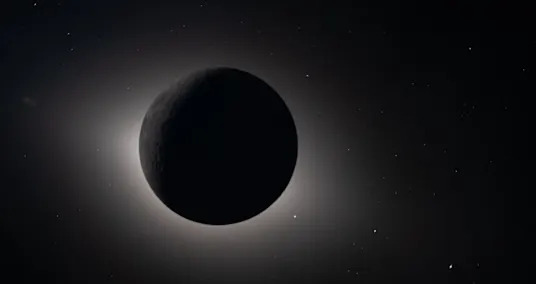
NASA's Artemis 2 astronauts have witnessed one of the rarest sights in spaceflight history — a total solar eclipse from beyond the moon.
The event unfolded yesterday (April 6) as the Orion spacecraft looped around the far side of the moon. This trajectory placed the crew in the right place at the right time to see the moon completely block the sun for about 53 minutes, which is far longer than the maximum period of totality for eclipses seen from Earth.
But it wasn't just the duration that made this eclipse extraordinary; it was the view.
NASA astronaut Victor Glover described the scene unfolding as the sun vanished behind the lunar disk.
"This continues to be unreal. The sun has gone behind the moon and the corona is still visible. It's bright and creates a halo almost around the entire moon," Glover said.
As darkness fell, another phenomenon quickly emerged. "When you get to the Earth side, the earthshine has already shown … almost seconds after the sun sets behind the moon, you can see earthshine," he added.
From Orion's windows, the crew was able to make out the faint glow of sunlight reflected off Earth, while stars and planets appeared in the background. The moon itself became a stark silhouette: "This black orb out in front of us," as Glover described it, edged by the glowing solar corona.

Though a rare sight, it's not the first time a solar eclipse has been viewed from lunar realms. The Apollo astronauts, who orbited the moon rather than flew by it (as Artemis 2 did), also saw solar eclipses, NASA's Kelsey Young, Artemis science flight operations lead, said during a press conference on Saturday (April 4).
The eclipse marks just one highlight in an already historic mission. Artemis 2 is the first crewed journey to the moon since Apollo 17 and has already set a new distance record for human spaceflight.
Following their impressive lunar flyby, the astronauts are now heading back toward Earth and are expected to splashdown on Friday (April 10) off the coast of San Diego.
latest_posts
- 1
 7 Strange Devices to Make Your Party Stick Out!
 - 2Al-Sharaa denies he called for 80% of Syrians to return from Germany
- 3The race to mine the moon is on – and it urgently needs some clear international rules
- 4Mars orbiter sees 'butterfly' crater spread its wings on the Red Planet
- 5Astronomers now say the moon is eating up molecules from Earth’s atmosphere




- France honors the victims of the Paris attacks' night of terror 10 years on
- 6 Monetary Arranging Administrations for Your Necessities
- As world leaders enter climate talks, people in poverty have the most at stake
- NASA probe captures stunning photos of Earth and moon on the way to infamous asteroid Apophis
- Tech Devices 2023: The Most blazing Arrivals of the Year
- Marvel's X-Men are joining the battle in 'Avengers: Doomsday': Watch the teaser
- Interstellar comet 3I/ATLAS will fly by Earth Friday. Here are the latest images
- Select Your Definitive Pizza Decision
- Turkey's Erdogan denounces Israel-Greece-Cyprus trilateral summit, affirms support for Gaza


